
.avif)
.avif)

Most people don’t really prepare for meetings. They skim the invite, scan a thread with some vague context, open an outdated notes doc from last quarter, and hope it’s enough to make a meaningful contribution.
That habit might have worked when calendars had breathing room and you could play catch up after the fact. It doesn’t work when professionals are moving from client calls to internal reviews to strategy sessions with barely enough time to reset between them. The cost stacks up: shallow conversations, repeated context, missed signals, and decisions that take longer than they should.
Our fast paced world demands faster execution and greater productivity. AI is helping organizations meet those demands. Meeting prep is becoming faster, more structured, and more strategic. The real shift isn’t just saving a few minutes before a call. It’s turning preparation into a competitive advantage.
Last-minute prep is breaking down
The old way of preparing for meetings was never especially good. It was just familiar.
Context lived anywhere and everywhere: emails, CRM notes, Slack threads, project docs, call recordings, spreadsheets, and dusty sticky notes sitting on the corners of desks. When meeting prep requires time most people don't have, preparation becomes inconsistent. The most organized person walks in with the full picture while everyone else relies on memory.
For client-facing teams, that can mean asking questions that have already been answered.
For managers, it can mean revisiting decisions that should have been settled.
For leadership teams, it can mean mistaking activity for alignment.
The issue isn’t that people don’t care. It’s that manual prep doesn’t scale with modern meeting volume. Forbes Technology Council member and Beautiful.ai Jason Lapp puts it well in his recent article: “The meeting was never the villain. Misalignment was.”
AI turns scattered context into usable insight
AI changes the first step of preparation: gathering the facts.
Instead of digging through tools manually, professionals can use AI to surface account or project history, identify open questions, and highlight risks or opportunities. The value isn’t so much that AI finds information faster (although it does). The bigger value is that it helps organize that information into something a person can actually use.
For instance, when a meeting attendee has a presentation to view, they’re less likely to have their attention diverted. If you’re leading, good slides help bring and keep eyes on the screen, especially in increasingly remote and hybrid work environments. But building a deck shouldn’t be another item on your meeting prep to-do list. AI can turn documents from the last meeting that you haven’t touched since into a presentation in minutes. Helping you move from somewhat to fully prepared.
A meeting prep brief shouldn’t be a data dump. It should help you understand what has happened, what has changed, where tension exists, and what deserves attention next.
AI moves prep from information retrieval to interpretation. That’s where the quality of the conversation improves.
Better prep creates better questions
Prepared people ask different questions. They’re not scrambling for context; their focus is on the bigger picture.
When you’ve already reviewed the basics, you don’t waste the meeting confirming what everyone should know. You can use the time to probe assumptions, clarify trade-offs, pressure-test next steps, and uncover what hasn’t been said yet.
This is where AI becomes more than a summarization tool. It can help identify gaps in the available context. It can suggest likely objections. It can surface inconsistencies between what was discussed last time and what’s on the agenda now. It can point out where the team may be missing a stakeholder, a metric, or a decision owner. Most importantly, it can surface the most relevant information from past notes, helping you avoid wasting time wading through meeting minutes that don't support your preparation.
The human still has to judge what matters. AI can highlight patterns, but it can’t fully understand the politics of a customer relationship, the nuance of an internal priority, or the tone of a sensitive conversation. That is exactly why the best prep is collaborative: AI helps you see more, and you decide what to do with it.
A better-prepared person doesn’t show up with more notes. They show up with sharper questions.
Teams need a shared prep standard
Individual prep is useful. Team-wide prep is where the operational value starts to compound.
When every person prepares differently, meetings depend too much on personal habits. One sales rep researches deeply. Another scans the CRM two minutes before the call. One manager sends context ahead of time. Another assumes everyone remembers the last discussion. The result is uneven meeting quality across the organization.
AI makes it easier to standardize preparation without simply adding process for its own sake. Lapp suggests that, “before a meeting ever hits the calendar, there should be a shared artifact.” Teams can create a repeatable prep structure in a document or deck that outlines the topics, goals, and discussion questions they know will come up repeatedly.
That structure removes guesswork. It also makes preparation easier to coach. Managers can review not just whether someone prepared, but whether they prepared in a way that supports better outcomes.
For cross-functional teams or globally distributed teams, a shared prep standard creates alignment before the meeting begins. Everyone understands the purpose, sees the same context, and knows what conversation or outcome the meeting is supposed to produce.
That alone can make meetings shorter, clearer, and far less repetitive.
Speed only helps when quality holds up
The most tempting promise of AI is speed. What used to take 30 minutes can now take five. That matters when calendars are packed and context-switching is constant.
But speed alone is not the goal. Faster bad prep is still bad prep.
A useful AI-assisted workflow should help professionals move quickly without skipping the thinking that makes preparation valuable. The workflow can be simple: pull context from relevant sources, ask AI to summarize and extract key themes, generate a short prep brief, then review and refine it before the meeting.
That final step is the one people can’t skip. AI can summarize the last five calls, but the person leading the meeting still needs to decide which thread matters most. AI can list risks, but the account owner needs to know which ones are politically sensitive. AI can draft questions, but the manager needs to choose the right moment to ask them.
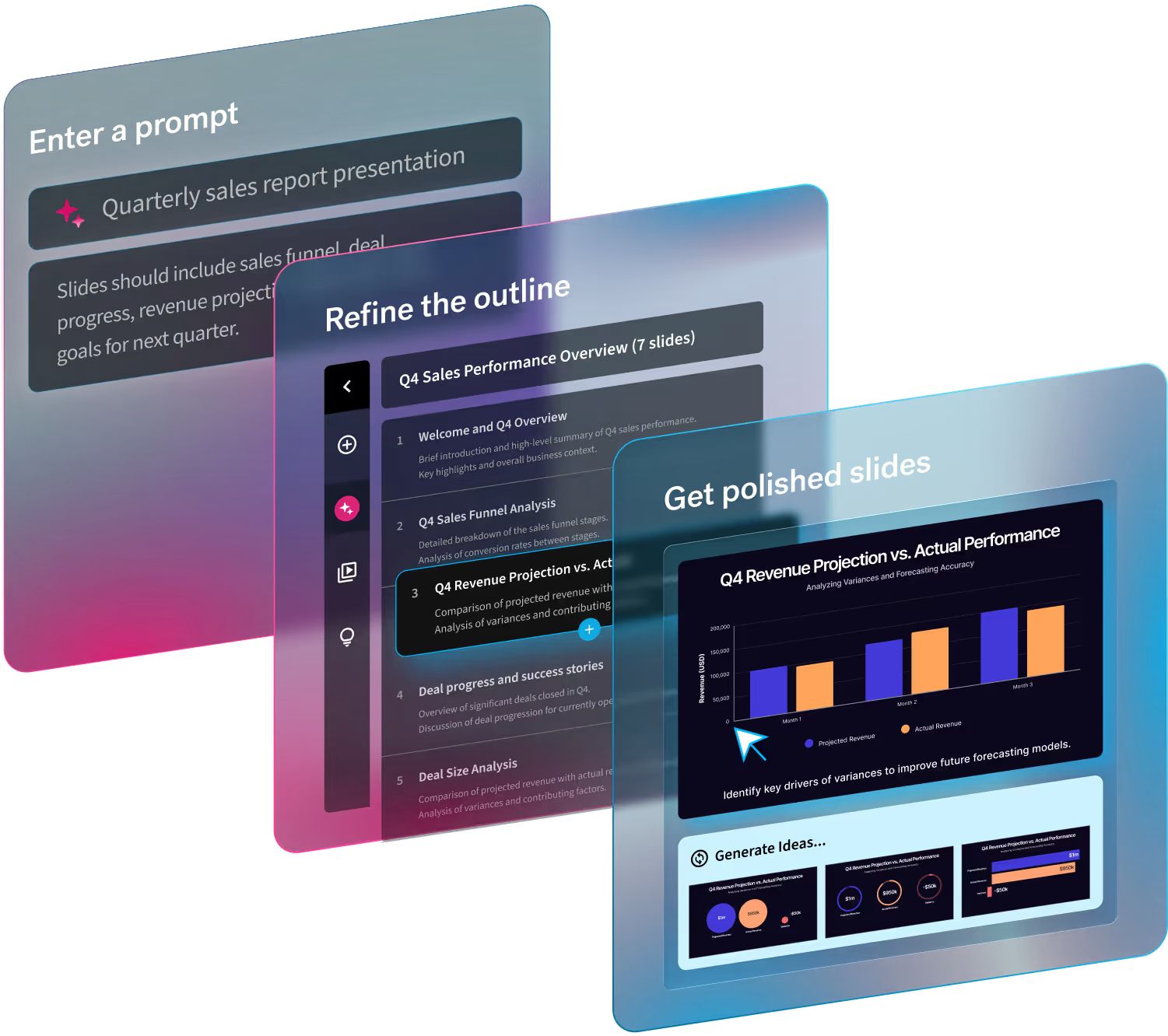
Beautiful.ai’s Create with AI Workflow is designed to take your notes, data, and ideas and turn them into professional presentations, without all the manual design work. An editable outline is generated from the context and prompting you provide. Your prep materials move from scattered notes to a structured, presentation-ready format in minutes.
The advantage comes from spending less time searching and more time thinking.
AI prep still needs human judgment
AI can make preparation easier, but it can also create new risks when people treat the output as final.
A summary can miss nuance. A generated brief can overemphasize details that aren’t actually important. An AI-generated question can sound reasonable but land badly in the room. When teams overload prep briefs with every possible detail, they recreate the same information problem they were trying to solve.
The best AI-assisted prep is focused. It starts with the meeting goal. Are you trying to make a decision? Move a deal forward? Resolve a blocker? Align stakeholders? Rebuild trust? The prep should serve that purpose.
Before relying on any AI-generated prep, professionals should ask: Is this accurate? Is it relevant? Is anything missing? What context do I know that the AI doesn’t? What should I leave out?
Never use an AI tool just to use it. Establish your use case. Find the best tool. Create a plan to optimize use. And always double check outputs. AI can raise the floor for preparation. Human judgment raises the ceiling.
Meeting prep isn’t just useful–it’s necessary
As AI becomes part of everyday workflows, expectations will rise. Bandwidths for meetings that begin with confusion are wearing thin. Leaders expect more from their teams when they know they have the tools to come prepared. And clients? They already have high expectations. The business that prepares well, works better. Buyers will notice that distinction.
This changes what preparation means. It’s no longer just a courtesy or a personal productivity habit. It becomes part of operational excellence.
For managers, that means building preparation into team workflows instead of hoping individuals find time. For leaders, it means modeling better meeting discipline by making objectives, context, and decisions clear upfront.
The best teams won’t use AI to cram more meetings into the day. They’ll use it to make the meetings they do have more useful.
Preparation is becoming a true advantage
AI doesn’t remove the need to prepare. That onus is still on the individual. But, it raises the standard for what preparation can look like.
Instead of arriving with scattered notes or half-remembered context, professionals can walk into meetings with a sharper understanding of the people, history, risks, and opportunities in front of them. Instead of spending valuable meeting time getting aligned, teams can start from a shared foundation and move straight into the work that matters.
That shift will be hard to ignore. In a workplace with more meetings, more tools, and more information than ever, the people who consistently arrive prepared will stand out. They will make stronger recommendations and move conversations forward faster.
The future of meetings won’t be defined by who has the most notes. It will be defined by who turns context into better outcomes.
Curious about turning your scattered prep materials into a professional, structured deck that keeps you showing up prepared for every meeting? Try Beautiful.ai, free for 14 days.

.avif)

.avif)
.gif)

